

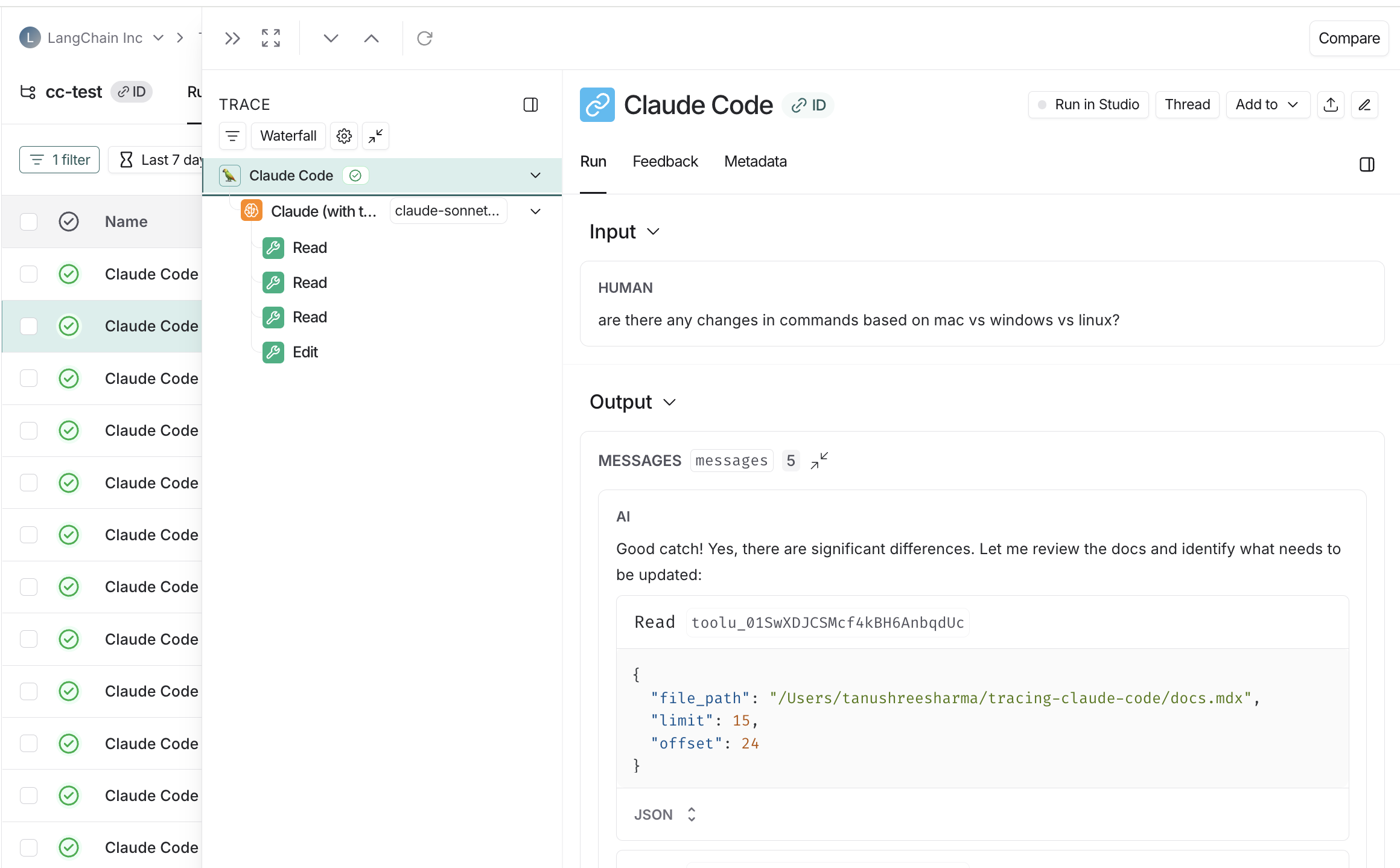
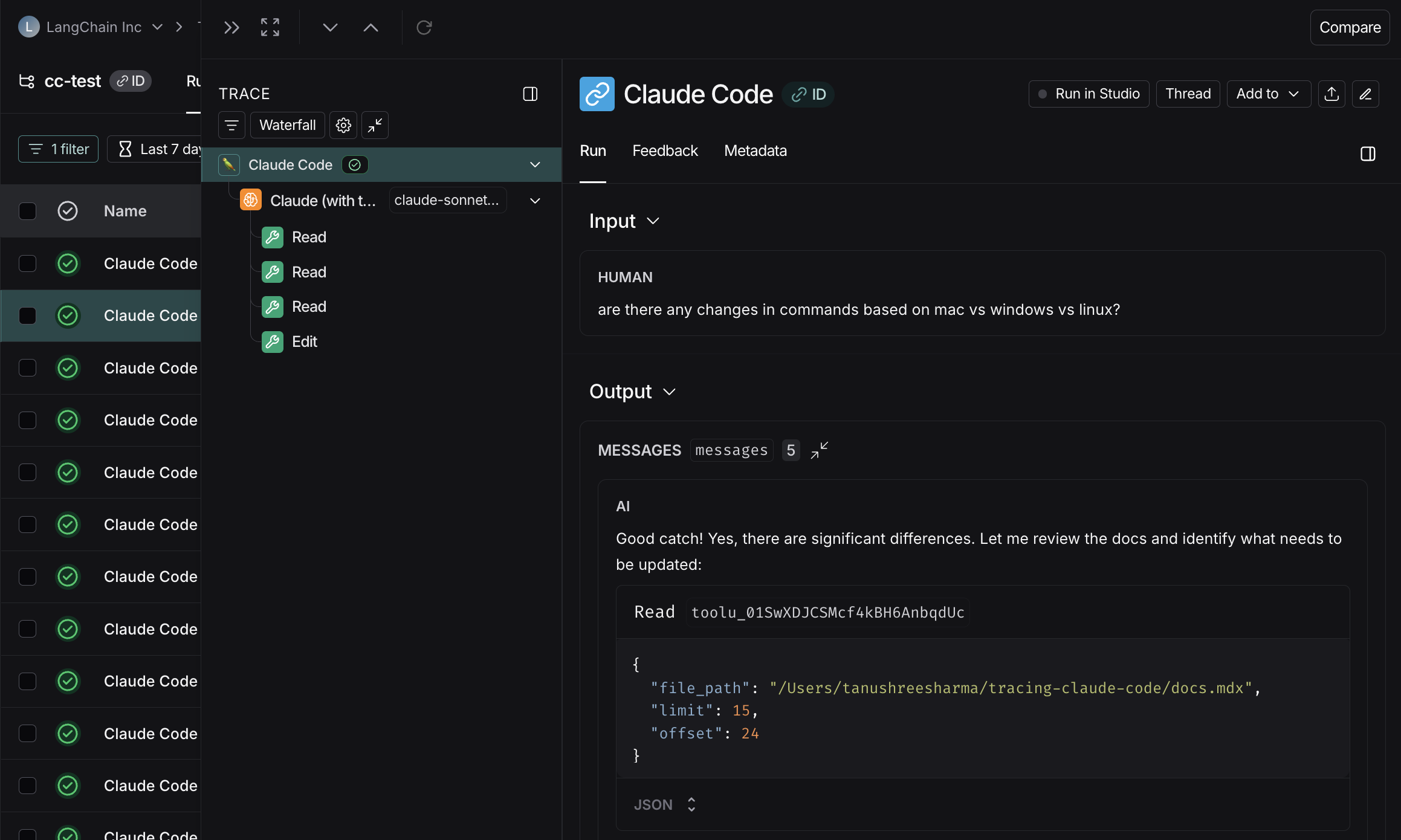
How it works
- A global “Stop” hook is configured to run each time Claude Code responds.
- The hook reads Claude Code’s generated conversation transcripts.
- Messages in the transcript are converted into LangSmith runs and sent to your LangSmith project.
Tracing is opt-in and is enabled per Claude Code project using environment variables.
Prerequisites
Before setting up tracing, ensure you have:- Claude Code CLI installed.
- LangSmith API key (get it here).
- Command-line tool
jq- JSON processor (install guide)
This guide currently only supports macOS.
1. Create the hook script
stop_hook.sh processes Claude Code’s generated conversation transcripts and sends traces to LangSmith. Create the file ~/.claude/hooks/stop_hook.sh with the following script:
`stop_hook.sh` file
`stop_hook.sh` file
#!/bin/bash
###
# Claude Code Stop Hook - LangSmith Tracing Integration
# Sends Claude Code traces to LangSmith after each response.
###

set -e

# Exit early if tracing disabled
if [ "$(echo "$TRACE_TO_LANGSMITH" | tr '[:upper:]' '[:lower:]')" != "true" ]; then
    exit 0
fi

# Required commands
for cmd in jq curl uuidgen; do
    if ! command -v $cmd &> /dev/null; then
        echo "Error: $cmd is required but not installed" >&2
        exit 0
    fi
done

# Config
API_KEY="${CC_LANGSMITH_API_KEY:-$LANGSMITH_API_KEY}"
PROJECT="${CC_LANGSMITH_PROJECT:-claude-code}"
API_BASE="https://api.smith.langchain.com"
STATE_FILE="$HOME/.claude/state/langsmith_state.json"
LOG_FILE="$HOME/.claude/state/hook.log"
DEBUG="$(echo "$CC_LANGSMITH_DEBUG" | tr '[:upper:]' '[:lower:]')"

# Ensure state directory exists
mkdir -p "$(dirname "$STATE_FILE")"

# Validate API key
if [ -z "$API_KEY" ]; then
    echo "$(date '+%Y-%m-%d %H:%M:%S') [ERROR] CC_LANGSMITH_API_KEY not set" >> "$LOG_FILE"
    exit 0
fi

# Logging function
log() {
    local level="$1"
    shift
    echo "$(date '+%Y-%m-%d %H:%M:%S') [$level] $*" >> "$LOG_FILE"
}

# Debug logging
debug() {
    if [ "$DEBUG" = "true" ]; then
        log "DEBUG" "$@"
    fi
}

# API call helper
api_call() {
    local method="$1"
    local endpoint="$2"
    local data="$3"

    debug "API call: $method $endpoint"

    local response
    local http_code
    response=$(curl -s -w "\n%{http_code}" -X "$method" \
        -H "x-api-key: $API_KEY" \
        -H "Content-Type: application/json" \
        -d "$data" \
        "$API_BASE$endpoint" 2>&1)

    http_code=$(echo "$response" | tail -n1)
    response=$(echo "$response" | head -n-1)

    debug "HTTP $http_code: ${response:0:200}"

    if [ "$http_code" -lt 200 ] || [ "$http_code" -ge 300 ]; then
        log "ERROR" "API call failed: $method $endpoint"
        log "ERROR" "HTTP $http_code: $response"
        log "ERROR" "Request data: ${data:0:500}"
        return 1
    fi

    echo "$response"
}

# Load state
load_state() {
    if [ ! -f "$STATE_FILE" ]; then
        echo "{}"
        return
    fi
    cat "$STATE_FILE"
}

# Save state
save_state() {
    local state="$1"
    echo "$state" > "$STATE_FILE"
}

# Get message content
get_content() {
    local msg="$1"
    echo "$msg" | jq -c 'if has("message") then .message.content else .content end'
}

# Check if message is tool result
is_tool_result() {
    local msg="$1"
    local content
    content=$(get_content "$msg")

    echo "$content" | jq -e 'if type == "array" then any(.[]; type == "object" and .type == "tool_result") else false end' > /dev/null 2>&1
}

# Format content blocks for LangSmith
format_content() {
    local msg="$1"
    local content
    content=$(get_content "$msg")

    # Handle string content
    if echo "$content" | jq -e 'type == "string"' > /dev/null 2>&1; then
        echo "$content" | jq '[{"type": "text", "text": .}]'
        return
    fi

    # Handle array content
    if echo "$content" | jq -e 'type == "array"' > /dev/null 2>&1; then
        echo "$content" | jq '[
            .[] |
            if type == "object" then
                if .type == "text" then
                    {"type": "text", "text": .text}
                elif .type == "tool_use" then
                    {"type": "tool_call", "name": .name, "args": .input, "id": .id}
                else
                    .
                end
            elif type == "string" then
                {"type": "text", "text": .}
            else
                .
            end
        ] | if length == 0 then [{"type": "text", "text": ""}] else . end'
        return
    fi

    # Default
    echo '[{"type": "text", "text": ""}]'
}

# Get tool uses from message
get_tool_uses() {
    local msg="$1"
    local content
    content=$(get_content "$msg")

    # Check if content is an array
    if ! echo "$content" | jq -e 'type == "array"' > /dev/null 2>&1; then
        echo "[]"
        return
    fi

    echo "$content" | jq -c '[.[] | select(type == "object" and .type == "tool_use")]'
}

# Find tool result
find_tool_result() {
    local tool_id="$1"
    local tool_results="$2"

    local result
    result=$(echo "$tool_results" | jq -r --arg id "$tool_id" '
        first(
            .[] |
            (if has("message") then .message.content else .content end) as $content |
            if $content | type == "array" then
                $content[] |
                select(type == "object" and .type == "tool_result" and .tool_use_id == $id) |
                if .content | type == "array" then
                    [.content[] | select(type == "object" and .type == "text") | .text] | join(" ")
                elif .content | type == "string" then
                    .content
                else
                    .content | tostring
                end
            else
                empty
            end
        ) // ""
    ')

    if [ -z "$result" ]; then
        echo "No result"
    else
        echo "$result"
    fi
}

# Create LangSmith trace
create_trace() {
    local session_id="$1"
    local turn_num="$2"
    local user_msg="$3"
    local assistant_messages="$4"  # JSON array of assistant messages
    local tool_results="$5"

    local turn_id
    turn_id=$(uuidgen | tr '[:upper:]' '[:lower:]')

    local user_content
    user_content=$(format_content "$user_msg")

    local now
    now=$(date -u +"%Y-%m-%dT%H:%M:%SZ")

    # Create top-level turn run
    local turn_data
    turn_data=$(jq -n \
        --arg id "$turn_id" \
        --arg name "Claude Code" \
        --arg project "$PROJECT" \
        --arg session "$session_id" \
        --arg time "$now" \
        --argjson content "$user_content" \
        --arg turn "$turn_num" \
        '{
            id: $id,
            name: $name,
            run_type: "chain",
            inputs: {messages: [{role: "user", content: $content}]},
            start_time: $time,
            session_name: $project,
            extra: {metadata: {thread_id: $session}},
            tags: ["claude-code", ("turn-" + $turn)]
        }')

    debug "Creating turn run: $turn_id"
    api_call "POST" "/runs" "$turn_data" > /dev/null

    # Build final outputs array (accumulates all LLM responses)
    local all_outputs
    all_outputs=$(jq -n --argjson content "$user_content" '[{role: "user", content: $content}]')

    # Process each assistant message (each represents one LLM call)
    local llm_num=0
    local last_llm_end="$now"
    while IFS= read -r assistant_msg; do
        llm_num=$((llm_num + 1))

        # Each LLM starts after the previous one ended
        local llm_start
        if [ $llm_num -eq 1 ]; then
            llm_start="$now"
        else
            llm_start="$last_llm_end"
        fi

        # Create assistant run
        local assistant_id
        assistant_id=$(uuidgen | tr '[:upper:]' '[:lower:]')

        local tool_uses
        tool_uses=$(get_tool_uses "$assistant_msg")

        local assistant_content
        assistant_content=$(format_content "$assistant_msg")

        # Build inputs for this LLM call (includes accumulated context)
        local llm_inputs
        llm_inputs=$(jq -n --argjson outputs "$all_outputs" '{messages: $outputs}')

        local assistant_data
        assistant_data=$(jq -n \
            --arg id "$assistant_id" \
            --arg parent "$turn_id" \
            --arg name "Claude" \
            --arg project "$PROJECT" \
            --arg time "$llm_start" \
            --argjson inputs "$llm_inputs" \
            '{
                id: $id,
                parent_run_id: $parent,
                name: $name,
                run_type: "llm",
                inputs: $inputs,
                start_time: $time,
                session_name: $project,
                extra: {metadata: {ls_provider: "anthropic", ls_model_name: "claude-sonnet-4-5"}},
                tags: ["claude-sonnet-4-5"]
            }')

        debug "Creating assistant run #$llm_num: $assistant_id"
        api_call "POST" "/runs" "$assistant_data" > /dev/null

        # Build outputs for this LLM call
        local llm_outputs
        llm_outputs=$(jq -n --argjson content "$assistant_content" '[{role: "assistant", content: $content}]')

        # Create tool runs
        if [ "$(echo "$tool_uses" | jq 'length')" -gt 0 ]; then
            # Tools start slightly after LLM start
            local tool_start="$llm_start"

            while IFS= read -r tool; do
                local tool_id
                tool_id=$(uuidgen | tr '[:upper:]' '[:lower:]')

                local tool_name
                tool_name=$(echo "$tool" | jq -r '.name // "tool"')

                local tool_input
                tool_input=$(echo "$tool" | jq '.input // {}')

                local tool_use_id
                tool_use_id=$(echo "$tool" | jq -r '.id // ""')

                local tool_data
                tool_data=$(jq -n \
                    --arg id "$tool_id" \
                    --arg parent "$assistant_id" \
                    --arg name "$tool_name" \
                    --arg project "$PROJECT" \
                    --arg time "$tool_start" \
                    --argjson input "$tool_input" \
                    '{
                        id: $id,
                        parent_run_id: $parent,
                        name: $name,
                        run_type: "tool",
                        inputs: {input: $input},
                        start_time: $time,
                        session_name: $project,
                        tags: ["tool"]
                    }')

                debug "Creating tool run: $tool_name ($tool_id)"
                api_call "POST" "/runs" "$tool_data" > /dev/null

                # Find and add tool result
                local result
                result=$(find_tool_result "$tool_use_id" "$tool_results")

                local tool_end
                tool_end=$(date -u +"%Y-%m-%dT%H:%M:%SZ")

                local tool_update
                tool_update=$(jq -n \
                    --arg time "$tool_end" \
                    --arg result "$result" \
                    '{
                        outputs: {output: $result},
                        end_time: $time
                    }')

                api_call "PATCH" "/runs/$tool_id" "$tool_update" > /dev/null

                # Next tool starts after this one ends
                tool_start="$tool_end"

                # Add to this LLM's outputs
                llm_outputs=$(echo "$llm_outputs" | jq \
                    --arg id "$tool_use_id" \
                    --arg result "$result" \
                    '. += [{role: "tool", tool_call_id: $id, content: [{type: "text", text: $result}]}]')

            done < <(echo "$tool_uses" | jq -c '.[]')
        fi

        # Update this assistant run
        local assistant_end
        assistant_end=$(date -u +"%Y-%m-%dT%H:%M:%SZ")

        local assistant_update
        assistant_update=$(jq -n \
            --arg time "$assistant_end" \
            --argjson outputs "$llm_outputs" \
            '{
                outputs: {messages: $outputs},
                end_time: $time
            }')

        api_call "PATCH" "/runs/$assistant_id" "$assistant_update" > /dev/null

        # Save end time for next LLM start
        last_llm_end="$assistant_end"

        # Add to overall outputs
        all_outputs=$(echo "$all_outputs" | jq --argjson new "$llm_outputs" '. += $new')

    done < <(echo "$assistant_messages" | jq -c '.[]')

    # Update turn run with all outputs
    # Filter out user messages from final outputs
    local turn_outputs
    turn_outputs=$(echo "$all_outputs" | jq '[.[] | select(.role != "user")]')

    # Use the last LLM's end time as the turn end time
    local turn_end="$last_llm_end"

    local turn_update
    turn_update=$(jq -n \
        --arg time "$turn_end" \
        --argjson outputs "$turn_outputs" \
        '{
            outputs: {messages: $outputs},
            end_time: $time
        }')

    api_call "PATCH" "/runs/$turn_id" "$turn_update" > /dev/null

    log "INFO" "Created turn $turn_num: $turn_id with $llm_num LLM call(s)"
}

# Main function
main() {
    # Read hook input
    local hook_input
    hook_input=$(cat)

    debug "Hook input: $hook_input"

    # Check stop_hook_active flag
    if echo "$hook_input" | jq -e '.stop_hook_active == true' > /dev/null 2>&1; then
        debug "stop_hook_active=true, skipping"
        exit 0
    fi

    # Extract session info
    local session_id
    session_id=$(echo "$hook_input" | jq -r '.session_id // ""')

    local transcript_path
    transcript_path=$(echo "$hook_input" | jq -r '.transcript_path // ""' | sed "s|^~|$HOME|")

    if [ -z "$session_id" ] || [ ! -f "$transcript_path" ]; then
        log "WARN" "Invalid input: session=$session_id, transcript=$transcript_path"
        exit 0
    fi

    log "INFO" "Processing session $session_id"

    # Load state
    local state
    state=$(load_state)

    local last_line
    last_line=$(echo "$state" | jq -r --arg sid "$session_id" '.[$sid].last_line // -1')

    local turn_count
    turn_count=$(echo "$state" | jq -r --arg sid "$session_id" '.[$sid].turn_count // 0')

    # Parse new messages
    local new_messages
    new_messages=$(awk -v start="$last_line" 'NR > start + 1 && NF' "$transcript_path")

    if [ -z "$new_messages" ]; then
        debug "No new messages"
        exit 0
    fi

    local msg_count
    msg_count=$(echo "$new_messages" | wc -l)
    log "INFO" "Found $msg_count new messages"

    # Group into turns
    local current_user=""
    local current_assistants="[]"  # Array of assistant messages
    local current_msg_id=""  # Current assistant message ID
    local current_assistant_parts="[]"  # Parts of current assistant message
    local current_tool_results="[]"
    local turns=0
    local new_last_line=$last_line

    while IFS= read -r line; do
        new_last_line=$((new_last_line + 1))

        if [ -z "$line" ]; then
            continue
        fi

        local role
        role=$(echo "$line" | jq -r 'if has("message") then .message.role else .role end')

        if [ "$role" = "user" ]; then
            if is_tool_result "$line"; then
                # Add to tool results
                current_tool_results=$(echo "$current_tool_results" | jq --argjson msg "$line" '. += [$msg]')
            else
                # New turn - finalize any pending assistant message
                if [ -n "$current_msg_id" ] && [ "$(echo "$current_assistant_parts" | jq 'length')" -gt 0 ]; then
                    # Merge parts and add to assistants array
                    local merged
                    merged=$(echo "$current_assistant_parts" | jq -s '
                        .[0][0] as $base |
                        (.[0] | map(if has("message") then .message.content else .content end)) as $contents |
                        ($contents | map(if type == "string" then [{"type":"text","text":.}] else . end) | add) as $merged_content |
                        $base | if has("message") then .message.content = $merged_content else .content = $merged_content end
                    ')
                    current_assistants=$(echo "$current_assistants" | jq --argjson msg "$merged" '. += [$msg]')
                    current_assistant_parts="[]"
                    current_msg_id=""
                fi

                # Create trace for previous turn
                if [ -n "$current_user" ] && [ "$(echo "$current_assistants" | jq 'length')" -gt 0 ]; then
                    turns=$((turns + 1))
                    local turn_num=$((turn_count + turns))
                    create_trace "$session_id" "$turn_num" "$current_user" "$current_assistants" "$current_tool_results" || true
                fi

                # Start new turn
                current_user="$line"
                current_assistants="[]"
                current_assistant_parts="[]"
                current_msg_id=""
                current_tool_results="[]"
            fi
        elif [ "$role" = "assistant" ]; then
            # Get message ID
            local msg_id
            msg_id=$(echo "$line" | jq -r 'if has("message") then .message.id else "" end')

            if [ -z "$msg_id" ]; then
                # No message ID, treat as continuation of current message
                current_assistant_parts=$(echo "$current_assistant_parts" | jq --argjson msg "$line" '. += [$msg]')
            elif [ "$msg_id" = "$current_msg_id" ]; then
                # Same message ID, add to current parts
                current_assistant_parts=$(echo "$current_assistant_parts" | jq --argjson msg "$line" '. += [$msg]')
            else
                # New message ID - finalize previous message if any
                if [ -n "$current_msg_id" ] && [ "$(echo "$current_assistant_parts" | jq 'length')" -gt 0 ]; then
                    # Merge parts and add to assistants array
                    local merged
                    merged=$(echo "$current_assistant_parts" | jq -s '
                        .[0][0] as $base |
                        (.[0] | map(if has("message") then .message.content else .content end)) as $contents |
                        ($contents | map(if type == "string" then [{"type":"text","text":.}] else . end) | add) as $merged_content |
                        $base | if has("message") then .message.content = $merged_content else .content = $merged_content end
                    ')
                    current_assistants=$(echo "$current_assistants" | jq --argjson msg "$merged" '. += [$msg]')
                fi

                # Start new assistant message
                current_msg_id="$msg_id"
                current_assistant_parts=$(jq -n --argjson msg "$line" '[$msg]')
            fi
        fi
    done <<< "$new_messages"

    # Process final turn - finalize any pending assistant message
    if [ -n "$current_msg_id" ] && [ "$(echo "$current_assistant_parts" | jq 'length')" -gt 0 ]; then
        local merged
        merged=$(echo "$current_assistant_parts" | jq -s '
            .[0][0] as $base |
            (.[0] | map(if has("message") then .message.content else .content end)) as $contents |
            ($contents | map(if type == "string" then [{"type":"text","text":.}] else . end) | add) as $merged_content |
            $base | if has("message") then .message.content = $merged_content else .content = $merged_content end
        ')
        current_assistants=$(echo "$current_assistants" | jq --argjson msg "$merged" '. += [$msg]')
    fi

    if [ -n "$current_user" ] && [ "$(echo "$current_assistants" | jq 'length')" -gt 0 ]; then
        turns=$((turns + 1))
        local turn_num=$((turn_count + turns))
        create_trace "$session_id" "$turn_num" "$current_user" "$current_assistants" "$current_tool_results" || true
    fi

    # Update state
    local updated
    updated=$(date -u +"%Y-%m-%dT%H:%M:%SZ")

    state=$(echo "$state" | jq \
        --arg sid "$session_id" \
        --arg line "$new_last_line" \
        --arg count "$((turn_count + turns))" \
        --arg time "$updated" \
        '.[$sid] = {last_line: ($line | tonumber), turn_count: ($count | tonumber), updated: $time}')

    save_state "$state"

    log "INFO" "Processed $turns turns"
}

# Run main
main 2>&1 | head -c 10000  # Limit output to prevent hanging

exit 0
chmod +x ~/.claude/hooks/stop_hook.sh
2. Configure the global hook
Set up a global hook in~/.claude/settings.json that runs the stop_hook.sh script. The global setting enables you to easily trace any Claude Code CLI project.
In ~/.claude/settings.json, add the Stop hook.
"hooks": {
  "Stop": [
    {
      "hooks": [
        {
          "type": "command",
          "command": "bash ~/.claude/hooks/stop_hook.sh",
          "timeout": 30
        }
      ]
    }
  ]
}
3. Enable Tracing
For each Claude Code project (a Claude Code project is a directory with Claude Code initialized) where you want tracing enabled, create or edit Claude Code’s project settings file.claude/settings.local.json to include the following environment variables:
TRACE_TO_LANGSMITH: "true"- Enables tracing for this project. Remove or set tofalseto disable tracing.CC_LANGSMITH_API_KEY- Your LangSmith API keyCC_LANGSMITH_PROJECT- The LangSmith project name where traces are sent- (optional)
CC_LANGSMITH_DEBUG: "true"- Enables detailed debug logging. Remove or set tofalseto disable tracing.
{
  "env": {
    "TRACE_TO_LANGSMITH": "true",
    "CC_LANGSMITH_API_KEY": "lsv2_pt_...",
    "CC_LANGSMITH_PROJECT": "project-name",
    "CC_LANGSMITH_DEBUG": "true"

  }
}
Alternativley, if you want tracing to LangSmith enabled for all Claude Code sessions, you can add the above JSON to your global Claude Code settings.json file.
4. Verify Setup
Start a Claude Code session in your configured project. Traces will appear in LangSmith after Claude Code responds. In LangSmith, you’ll see:- Each message to Claude Code appears as a trace.
- All turns from the same Claude Code session are grouped using a shared
thread_idand can be viewed in the Threads tab of a project.
Troubleshooting
No traces appearing in LangSmith
-
Check the hook is running:
You should see log entries after each Claude response.
tail -f ~/.claude/state/hook.log -
Verify environment variables:
- Check that
TRACE_TO_LANGSMITH="true"in your project’s.claude/settings.local.json - Verify your API key is correct (starts with
lsv2_pt_) - Ensure the project name exists in LangSmith
- Check that
-
Enable debug mode to see detailed API activity:
Then check logs for API calls and HTTP status codes.
{
  "env": {
    "CC_LANGSMITH_DEBUG": "true"
  }
}
Permission errors
Make sure the hook script is executable:chmod +x ~/.claude/hooks/stop_hook.sh
Required commands not found
Verify all required commands are installed:which jq curl uuidgen
jq is missing:
- macOS:
brew install jq - Ubuntu/Debian:
sudo apt-get install jq
Managing log file size
The hook logs all activity to~/.claude/state/hook.log. With debug mode enabled, this file can grow large:
# View log file size
ls -lh ~/.claude/state/hook.log

# Clear logs if needed
> ~/.claude/state/hook.log
Connect these docs programmatically to Claude, VSCode, and more via MCP for real-time answers.